Where the Money Is · Issue 02 · 20 October 2026
Six UK brands are for sale. The buyers will ask one question the sellers haven't.
The gap between what sellers want and what buyers will pay is usually one missing page.
Private equity is heading for the exit on Britain's high street.
Morrisons, PizzaExpress, Itsu, Waterstones, Poundland and Third Space are all being lined up for sale, the FT reported last week. Boots went to the Weston family for £6.7bn the week before. UK retail deals are at $10.1bn this year, double 2025.
The sellers bought in 2021, when money was cheap. They've held longer than they planned. Now they need to return capital.
Here's the line that matters, from the trade press: "finding a new owner may prove easier than agreeing what their businesses are worth."
That's the whole story. Not the exits. The valuation gap.
Why the gap exists.
A PE-owned company usually has a value creation plan. The deal team wrote it. It lives in a spreadsheet, organised by lever: cost out, pricing, store rationalisation, digital.
What it almost never has is a page that says which product-markets carry the earnings, and who owns each one.
So when a buyer walks in and asks the only question that sets a price - "where does next year's EBITDA actually come from, and why should I believe it?" - the answer is the consolidated number and a bridge.
Morrisons is the clearest case. Bought for £7bn. Losing ground to Tesco, Sainsbury's and the discounters. Sainsbury's looked at it and walked away in February over price. Not over the stores. Over what the stores were worth.
A grocer is not one business. It is convenience, large-format, online, wholesale and fuel, each in a different competitive set with a different margin. The buyer wants to know which of those is winning and which is being carried. If the seller can't show it by cell, the buyer discounts the whole thing. That is where the gap lives.
The pattern in almost every exit I've been near.
The sponsor's plan was built top-down, by lever. The management team ran the business bottom-up, by unit. The two never met on one page.
Then the exit arrives and everyone tries to write that page in six weeks, backwards, for a buyer who knows exactly what's missing.
The companies that clear their valuation did the work in year one, not year four.
The tool
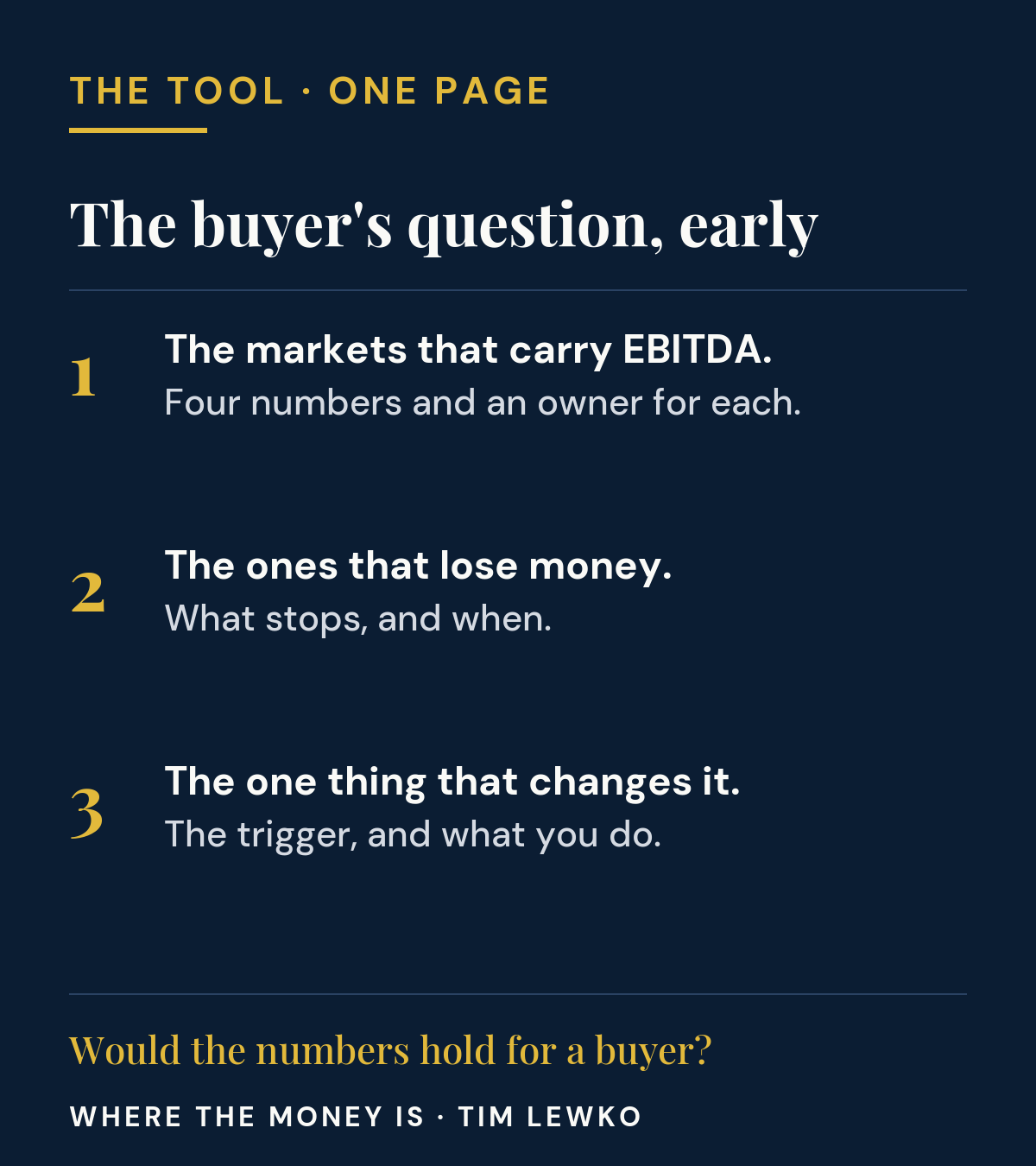
The buyer's question, two years early
Take the business as it stands today. Write the page a buyer would demand:
- The three to five product-markets that carry the EBITDA. Profit, revenue, margin, volume for each. A named owner.
- The two or three that lose money or hold margin below the group. What stops, and when.
- The one thing that would change the answer: a competitor move, a cost shift, a regulatory change. The trigger, and what you do if it fires.
If your management accounts can't fill in that page, a buyer will discount your price for the same reason. The gap exists now. You'll find out its size when someone makes an offer.
MOVE®, the system I use, builds this page with the executive team in a day and reviews it against actuals every month. Buyers price you on these questions either way. Better to have the answers before they ask.
Forward this to your sponsor, or to your CFO.
If a buyer walked in today, which three product-markets would we show them, and would the numbers hold?
Tim
Tim Lewko is the author of MOVE (Routledge) and CEO of Thinking Dimensions Global. Twenty-five years, 100+ CEO engagements, $2B+ in client EBITDA. tlewko@thinkingdimensions.ca
Sources: Financial Times, 12 October 2026; Retail Gazette, 13 October 2026.
Talk to Tim.
A short note about the decision in front of you is enough. Tim replies personally.
Or ask for a one-page view of your business, from public data, the same day.
MOVE® is available to license, embed or own. License MOVE · Tim is CEO of Thinking Dimensions Global