Where the Money Is · Issue 03 · 27 October 2026
Microsoft didn't cut 60,000 jobs. It published its strategy.
Read who was offered a buyout and who was not. The list is a map of the strategy.
Microsoft offered buyouts to 60,000 people yesterday. About a quarter of the company.
The same company is spending $175 billion on AI infrastructure this year.
Those two numbers are one decision. The money for the bet is coming out of the layer the bet replaces.
Read what was offered and what was not.
Eligible: AI experiences, Copilot, finance, HR, Xbox, Windows and devices.
Excluded: sales, security, the commercial business. Some engineering teams opted out.
That is not a cost cut. A cost cut is a percentage across the board. This is a map. The product-markets that carry the next five years are protected. The ones being absorbed are offered the door. Every team can read the strategy from the list.
Many companies do the opposite. The AI budget is a new line, approved at the top, with no exit funding it and no product-market it is tied to. Twelve months later the spend is real and the return is "being evaluated."
The pattern in almost every company I've been in the room with.
The board asks where AI will change the P&L. The answer is a programme, a vendor and a headcount request. What it is almost never is a product-market, a line on that cell's P&L, and the thing that stops to pay for it.
Microsoft has 223,000 people and can afford to be explicit. A $600 million industrial can afford it more, because it has less room for a bet that is funded by hope.
Two questions a CEO can ask this week that many AI plans can't answer. Which cell does this change, and by how much. And what are we no longer going to do.
The tool
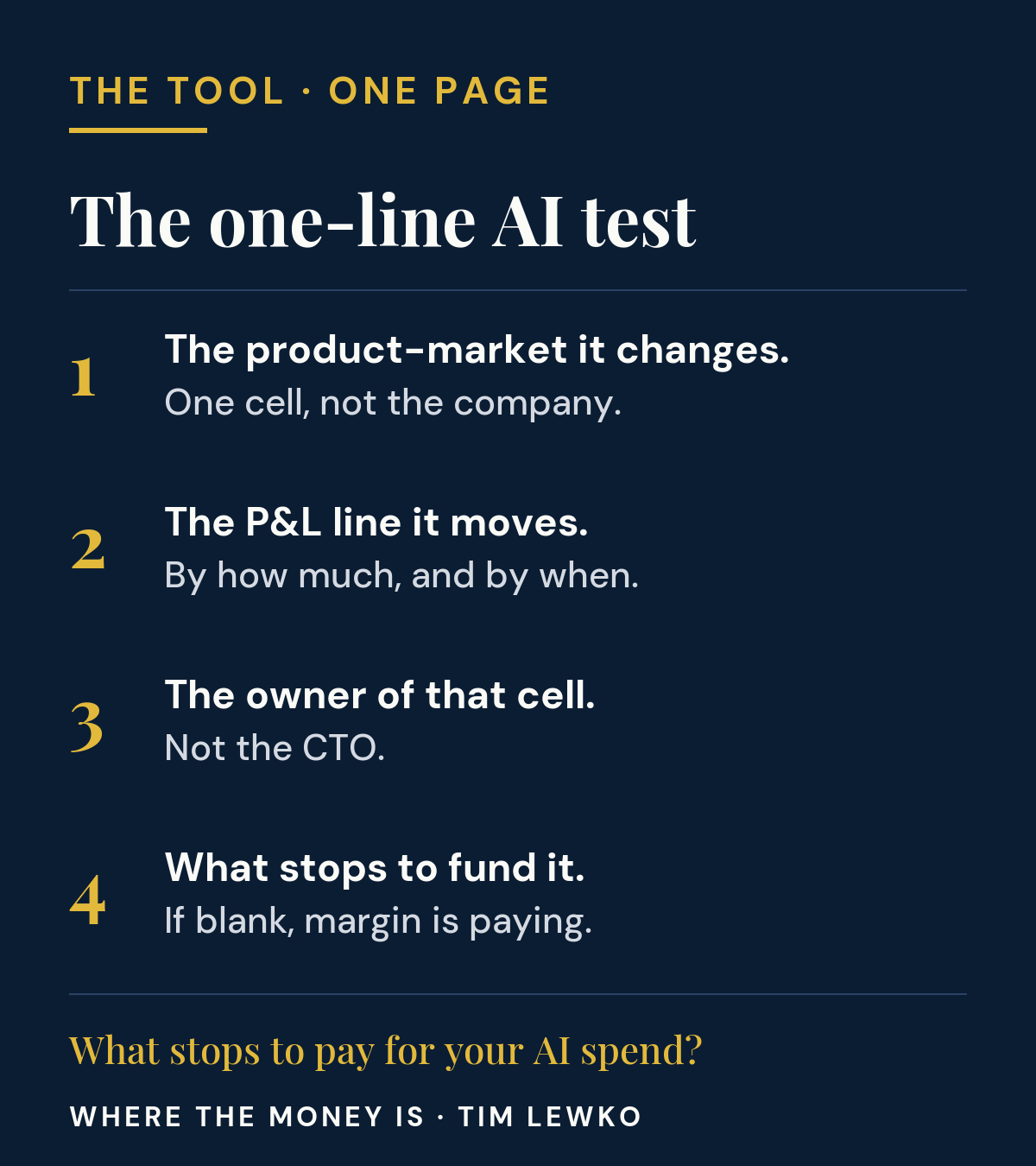
The one-line AI test
For each AI initiative in the plan, one line, four columns:
- The product-market it changes. One cell, not "the company."
- The P&L line it moves, and by how much, with a date.
- The named owner of that cell. Not the CTO.
- What stops, or shrinks, to fund it.
If column one says "enterprise-wide," it is a technology project, not a strategic bet. If column four is blank, the board is funding it from next year's margin and nobody has said so.
MOVE®, the system I use, treats AI as a capability applied to a product-market that already has a strategy. Microsoft's list is what that looks like at scale.
Forward this to whoever owns your AI budget.
Which product-market does our AI spend change, and what stops to pay for it?
Tim
Tim Lewko is the author of MOVE (Routledge) and CEO of Thinking Dimensions Global. Twenty-five years, 100+ CEO engagements, $2B+ in client EBITDA. tlewko@thinkingdimensions.ca
Sources: Reuters and CNBC, 26 October 2026; Financial Times, 27 October 2026.
Talk to Tim.
A short note about the decision in front of you is enough. Tim replies personally.
Or ask for a one-page view of your business, from public data, the same day.
MOVE® is available to license, embed or own. License MOVE · Tim is CEO of Thinking Dimensions Global