Where the Money Is · Issue 04 · 3 November 2026
Alstom has missed its profit forecast every year since 2018. A new CEO found out why.
Eight years of misses is not a bad quarter. It is a monthly review that reports a blended number.
Alstom cut its profit forecast for the second time this year on Monday. The shares fell by a quarter.
The new CEO, Martin Sion, took over in April. He warned then. He warned again this week, after a review of the project book found bigger problems in Germany than the last review had.
Margin guidance went from about 6.5% to about 1%. Free cash flow from positive to minus €1.5 billion. A €2 billion debt plan to protect the credit rating.
The German problem is six regional train contracts worth about €5 billion, the ones that were meant to drive this year's growth. All six are now loss-making.
The FT's line this morning: Alstom has missed analysts' forecasts every year since 2018.
Eight years is not a bad quarter. It is a review process that does not find the miss until it is too big to hide.
Here is what that process usually looks like, in almost every company I've been in the room with.
The number is reviewed at the consolidated level. "The group is behind plan by X." A programme is announced. The next quarter, the group is behind plan by a bigger X. The root cause is found by the new CEO, or the auditor, or the market, long after the people running the contracts knew.
Alstom is not one business. It is rolling stock, signalling, services and systems, across dozens of countries, each one a different margin and a different risk. A group margin forecast of 6.5% can hide six German contracts going from the growth engine to loss-making. It did.
The miss did not happen in October. It happened by product-market, month by month, where nobody was looking.
A new CEO inherits the review process along with the number.
The first thing Sion did right was commission the review. The thing the review proves is that the monthly rhythm he inherited was reporting a blended number to people who could not act on it.
The fix is not a better forecast. It is a different question, asked every month: where is the variance, by product-market, why, and what was decided. Never on the consolidated number.
When that question is asked monthly, a German project book that is bleeding shows up in month two, with an owner's name beside it. When it is asked annually, it shows up in a profit warning.
The tool
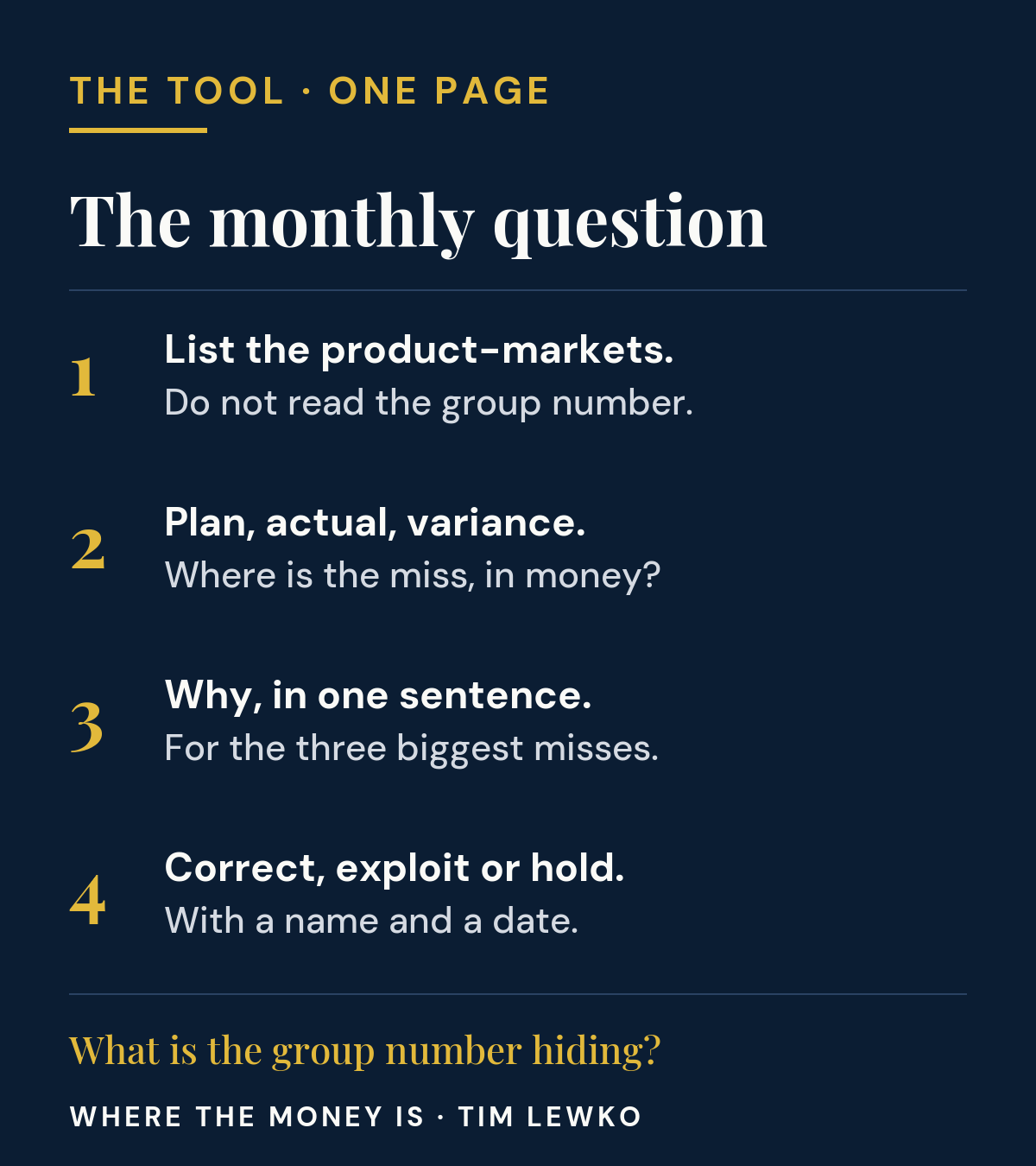
The monthly question, by product-market
Take last month's actuals. Do not read the group number.
- List the product-markets. Product line, customer segment, geography. Ten to twenty rows.
- For each one: plan, actual, variance. Where is the miss, in money.
- For the three biggest misses: why, in one sentence. Not "market conditions." The specific cause the person running that cell already knows.
- For each: correct, exploit, or hold, with a name and a date. "Monitor" is not a decision.
One page. An hour. It is the review that MOVE®, the system I use, runs every month after the strategy is set. It is also the review that would have found Alstom's German problem before it was €1.5 billion.
Forward this to whoever runs your monthly review.
Which product-market is our consolidated number hiding this month?
Tim
Tim Lewko is the author of MOVE (Routledge) and CEO of Thinking Dimensions Global. Twenty-five years, 100+ CEO engagements, $2B+ in client EBITDA. tlewko@thinkingdimensions.ca
Sources: Reuters, 2 November 2026 (Alstom H1 results and outlook); Financial Times, 3 November 2026.
Talk to Tim.
A short note about the decision in front of you is enough. Tim replies personally.
Or ask for a one-page view of your business, from public data, the same day.
MOVE® is available to license, embed or own. License MOVE · Tim is CEO of Thinking Dimensions Global