Where the Money Is · Issue 05 · 11 November 2026
Honda's change of mind cost up to $15.7bn. Exxon's cost nothing.
Two reversals in one week. The difference was a written assumption, with the trigger that would change it.
Two of the world's largest companies changed their minds this week.
On Monday Honda announced a $3 billion plant in Ohio. The FT calls it Honda's first new American plant in two decades. From 2029 it will build hybrids and petrol cars.
The same day ExxonMobil signed a memorandum with Venezuela, a country its chief executive called "uninvestable" in January.
One of those reversals cost up to $15.7 billion. The other cost nothing.
Honda first.
In 2021 it set a target: only electric and fuel-cell vehicles by 2040. An Ohio factory was retooled. A new electric range was designed.
Then the American EV market slowed. In March Honda cancelled three electric models planned for North America and booked charges of up to $15.7 billion. It went on to report its first annual loss since it listed in 1957. Electric cars were 2.5% of its sales.
Now Exxon.
It left Venezuela in 2007 after its assets were nationalised. In January its CEO told a White House meeting the country was uninvestable. This week's memorandum commits no capital. And the company published its conditions: stable policies, clear regulations, strong investment protections, competitive returns.
That sentence is the difference.
Exxon's position was not "no." It was "not until these four things are true." When the facts moved, the decision could move, and it cost nothing to move it.
Honda's plan was a date.
Almost every strategy I've seen in the room rests on five or six assumptions about the outside world. A growth rate. A regulation. A competitor's next move. A cost.
In many companies they are not written down. They sit inside the forecast, where they look like facts. Nobody is assigned to watch them. So when one breaks, the company finds out from the P&L, a year late, and the correction is a writedown.
It is worth noticing what Honda did next. The new Ohio plant will build hybrids and petrol cars, and it is designed so that it can build electric ones too.
That is a bet with the exit built in. An expensive lesson, and a learned one.
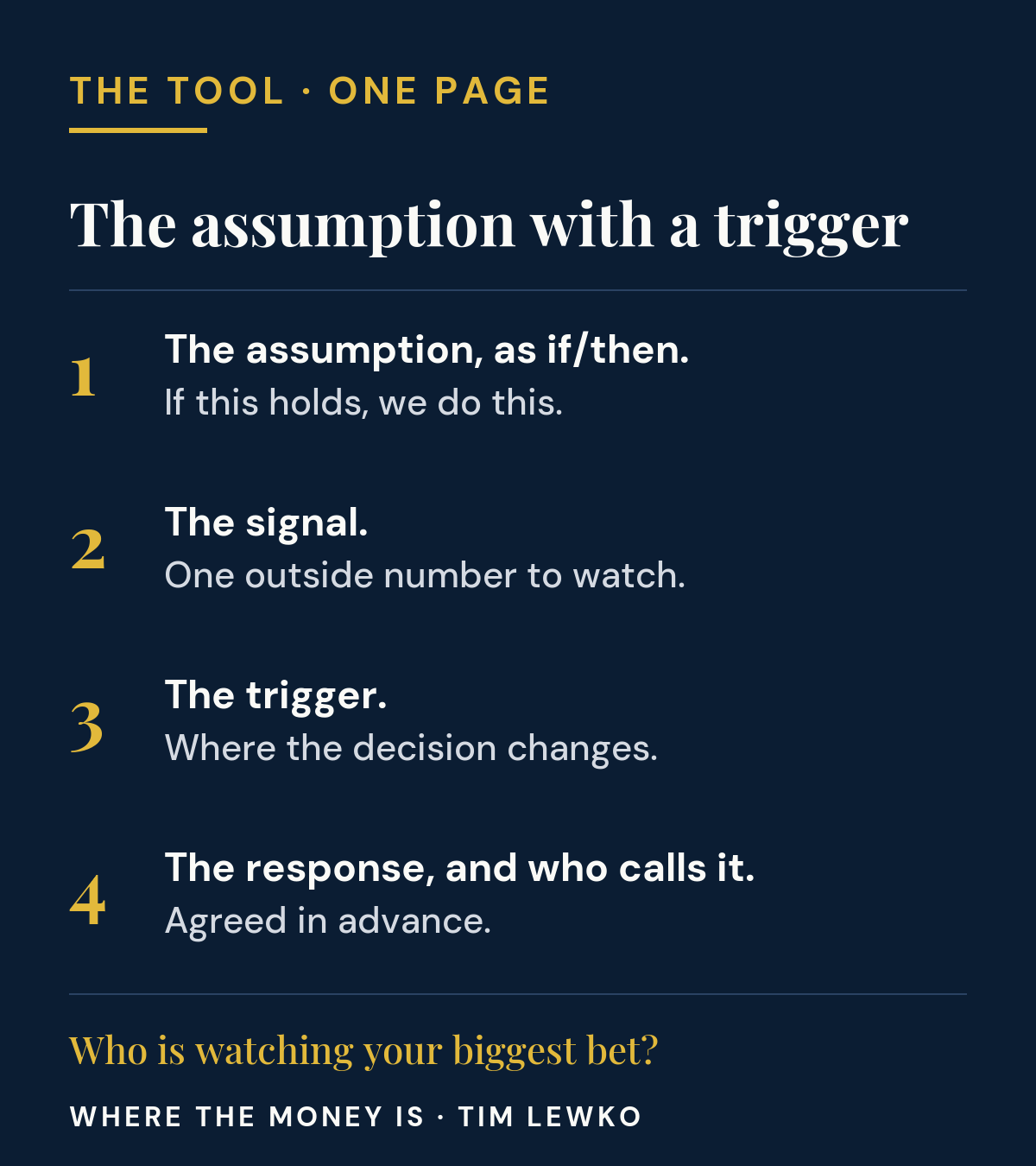
The tool
The assumption with a trigger
For each of your three biggest bets, one line with four parts:
- The assumption, written as if/then. If this trend runs at this rate, then we do this.
- The signal. The one outside number that tells you the assumption is holding.
- The trigger. The level at which the decision changes.
- The response, agreed in advance, and the name of the person who makes the call.
It takes an afternoon. It is where MOVE®, the system I use, begins: assumptions made visible before the money moves, and checked every month after.
Forward this to whoever owns your largest capital decision.
What would have to be true for our biggest bet to be wrong, and who is watching for it?
Tim
Tim Lewko is the author of MOVE (Routledge) and CEO of Thinking Dimensions Global. Twenty-five years, 100+ CEO engagements, $2B+ in client EBITDA. tlewko@thinkingdimensions.ca
Sources: Honda announcements, 12 March and 9 November 2026; Reuters, 13 March 2026; ExxonMobil statement, 9 November 2026; NPR, 11 November 2026; Financial Times, 10 November 2026.
Talk to Tim.
A short note about the decision in front of you is enough. Tim replies personally.
Or ask for a one-page view of your business, from public data, the same day.
MOVE® is available to license, embed or own. License MOVE · Tim is CEO of Thinking Dimensions Global