Where the Money Is · Issue 06 · 17 November 2026
Chevron could have bought more Texas shale. Its $5bn is going elsewhere.
Two $5bn oil deals in one week, in opposite directions. Each company knows what it will not buy.
Chevron and Diamondback both moved on $5 billion deals this week.
Diamondback Energy announced on Monday that it is buying out its partner, Double Eagle, in the Midland Basin of west Texas. About 176,000 net acres and more than 1,200 future drilling locations, for $2.15 billion in cash plus stock.
The same day the FT reported that Chevron is close to a deal valued at about $5 billion with Beacon Offshore Energy, a Blackstone-backed producer in the deepwater Gulf.
Same industry. Same week. Same size of cheque.
One is buying more shale. The other is buying something else.
Diamondback first.
It drills in one place, the Permian. It bought an earlier Double Eagle business in 2025 for about $4.1 billion. This week it bought the 40% of a joint venture it did not already own. It is paying for ground next to ground it already drills.
Now Chevron.
Chevron is one of the largest producers in the same basin. It could have bid for the same acres. It has said it will hold its Permian output at about 1 million barrels a day and spend less there, and take the cash.
Its growth is aimed elsewhere. It wants 300,000 barrels a day from the Gulf by the end of this year. Beacon's Shenandoah field reached 100,000 barrels a day in October 2025.
Neither company is confused. Each one knows what it is.
Diamondback is the low-cost operator in one basin, so it buys more of that basin. Chevron has decided the same basin is a source of cash, not growth, so it buys where the growth is.
In many companies I've been in the room with, that second sentence is missing.
The strategy says where the company will grow. It rarely says which businesses are there to fund the growth, or what the company will not buy.
So every deal that arrives gets judged on price. A good price in the wrong place looks like an opportunity. Capital spreads evenly, and the best market gets the same share as the weakest.
Chevron did not need a meeting to pass on Midland acreage. The decision had been made before the banker called.
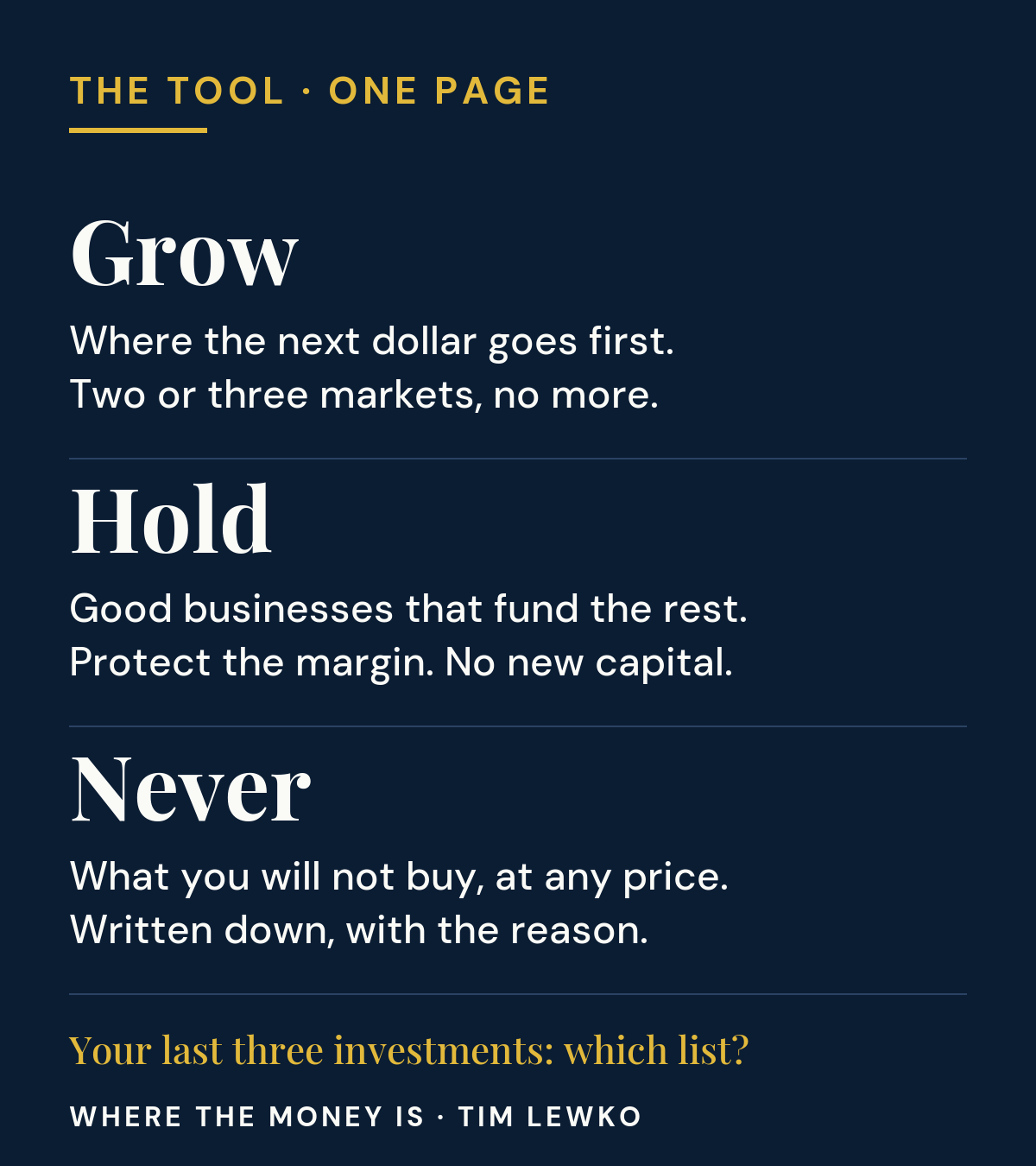
The tool
Grow, hold, never
One page. Three lists. Every product-market goes in one of them.
- Grow. Where the next dollar of capital goes first. Two or three, no more.
- Hold. Good businesses that fund the rest. Protect the margin. No new capital beyond that.
- Never. What you will not enter or buy, at any price, written down with the reason.
Then test it. Take the last three investments you approved. Which list was each in?
It takes an hour. In MOVE®, the system I use, it is the first page: where the company plays, and where it does not.
Forward this to whoever brings you deals.
What would we turn down, even at a good price?
Tim
Tim Lewko is the author of MOVE (Routledge) and CEO of Thinking Dimensions Global. Twenty-five years, 100+ CEO engagements, $2B+ in client EBITDA. tlewko@thinkingdimensions.ca
Sources: Diamondback Energy announcement, 16 November 2026 (World Oil; Oil & Gas Journal); Financial Times and Reuters, 16 November 2026 (Chevron and Beacon Offshore); Chevron investor statements on Permian and Gulf production.
Talk to Tim.
A short note about the decision in front of you is enough. Tim replies personally.
Or ask for a one-page view of your business, from public data, the same day.
MOVE® is available to license, embed or own. License MOVE · Tim is CEO of Thinking Dimensions Global